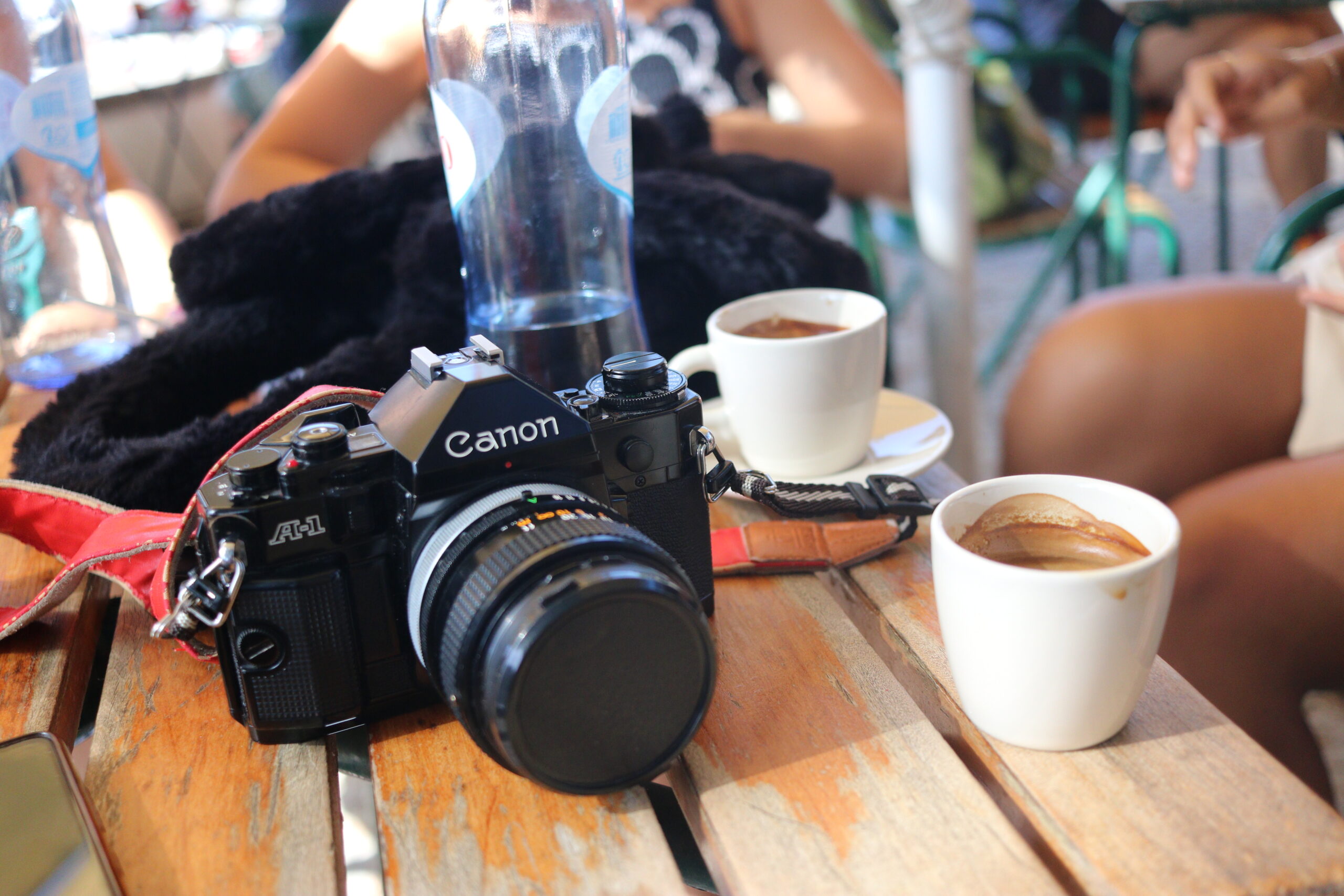
Both photos on this page came from café tables. In one, a Canon A-1 film camera sits in the sun on a slatted terrace table next to two cups of coffee. In the other, a mirrorless camera shares a wooden table in New York with a flat white and an almond pastry. You’ve probably seen a thousand pictures like them, because coffee has become one of the everyday things people photograph without thinking, and that has changed what cafés look like and what they serve.
We’re not above it. We took both pictures, and we’d take them again. But it’s worth looking at how much the camera now shapes what ends up in the cup.
The Cup Became a Photo Set
Instagram arrived in 2010, and coffee suited it perfectly. It’s cheap, it’s there every day and it looks good from above, especially with a heart or a rosetta of latte art on top. A standard shot soon took hold: the cup from overhead on a marble table, with a pastry at the edge of the frame.
That shot has a deadline. Latte art starts to fade within two or three minutes of pouring, as the foam drains and the bubbles grow, so the photo has to happen before the first sip. Glass helps the picture as well. A cortado in a small glass shows its color and its layer of foam from the side, which is part of why coffee in glass, the Gibraltar tumbler included, photographs so well.
Cafés Built for the Camera
Cafés noticed. The look that spread through specialty coffee in the 2010s, with white walls, pale wood, big windows and a marble counter, works as well for photographs as it does for drinking coffee. The writer Kyle Chayka gave it a name in 2016, AirSpace, along with a line about a dry cortado with perfect latte art on a marble countertop that we quote in our piece on % Arabica and Blue Bottle. Both chains did most of their growing in the Instagram years, and their cafés look the part.
South Korea took it furthest. The country had more than 100,000 coffee shops by the end of 2022, and South Koreans drank an estimated 405 cups of coffee each in 2023. With that many cafés competing on the same streets, looking good in a photo became one way to stand out, and hopping between photogenic cafés became a pastime of its own in Seoul.
Drinks Made to Be Seen
Then the drinks changed. In April 2017 Starbucks sold its Unicorn Frappuccino for a few days: a purple drink streaked with pink and blue powder that changed color and flavor as you stirred it. It was all over Instagram, and baristas complained online about the demand and the work of making it. It came back in 2026, first at the Coachella festival and then for one weekend in stores.
In March 2020, with people stuck at home in lockdown, dalgona coffee took over TikTok. It’s instant coffee, sugar and hot water whipped into a thick foam and spooned over milk. The drink itself dates from a café in Macau in 1997, but the name came from the South Korean actor Jung Il-woo, who tried it there on television in January 2020 and said it tasted like dalgona, a Korean honeycomb candy. The videos of people whipping it by hand did as much for it as the taste, and before long cafés in South Korea and the United States had it on the menu.
Later that year Dunkin’ put a TikTok star’s usual order on its menu. The Charli, named for Charli D’Amelio, was cold brew with whole milk and three pumps of caramel swirl. It launched on September 2, 2020, and Dunkin’ said it sold hundreds of thousands in the first five days. App downloads jumped 57% on launch day, and cold brew sales rose 20% that day and 45% the next.
The Experts Moved Online Too
It isn’t all colored foam. Some of coffee’s best-known teachers are YouTubers now. James Hoffmann won the World Barista Championship in 2007, co-founded London’s Square Mile Coffee Roasters the next year and started his YouTube channel in 2016. It has about 2.5 million subscribers. He reviews grinders and home espresso machines, the same kind of gear we cover in our grinder buying guide, and for a lot of home baristas his videos are where the research starts.
The Camera on the Table
The cameras in our photos are part of the look as well. The Canon A-1 came out in 1978. It was the first SLR with a programmed auto-exposure mode and the first with all four of the exposure modes cameras still use today, and it was made until 1985. Film cameras like it have had a second life with younger photographers, and one sitting next to a coffee says something about whoever put it there. Fujifilm had its own moment when its X100V compact became a TikTok sensation. When the follow-up, the X100VI, came out in 2024, demand was still running ahead of production late in the year.
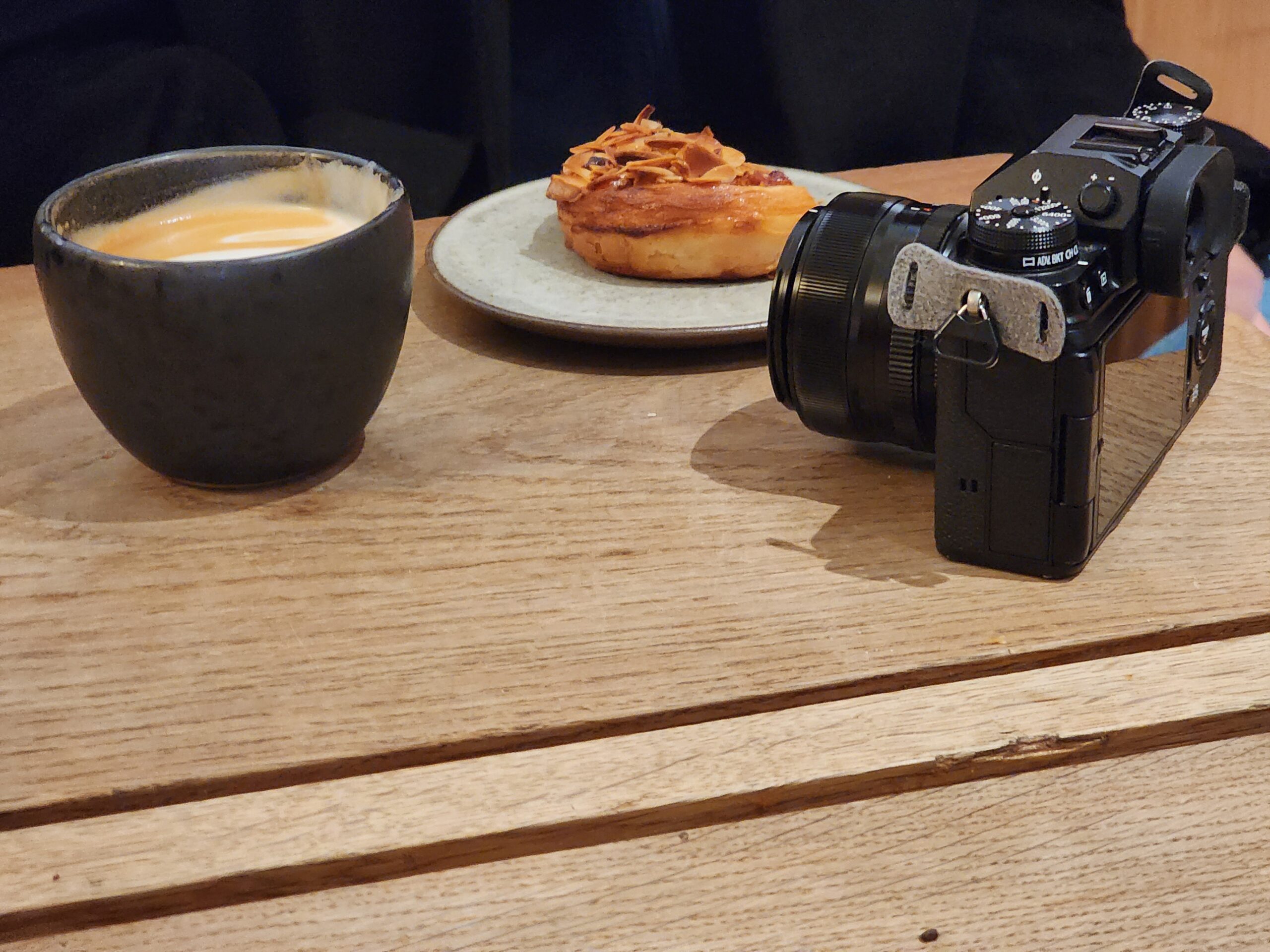
One detail gives the game away. The picture of that mirrorless camera beside the flat white was taken on a phone. The camera on the table is part of the scene, and the phone does the posting. For most coffee pictures on Instagram or TikTok, the phone is the whole kit.
Good for Coffee?
Not all of it is. A drink designed to photograph well doesn’t have to taste good, and cafés built for the feed can end up looking the same from Brooklyn to Seoul. The camera has done coffee some favors too, though. It made baristas’ skill visible, from the milk to the pour, and it gave small cafés a way to be found without a marketing budget.
So take the picture if you want to. Just take it quickly. A cortado is gone in a few sips, and the latte art won’t wait for you either.