Walk up to the counter of a busy Palermo bar and the machine behind it is usually something ordinary. A two-group workhorse, a bit scratched, pulling shot after shot by the button. Sometimes you get this one instead. Three groups, polished steel, a small screen over each group and a row of Stagnitta cups warming on top. It’s a Victoria Arduino Black Eagle, the machine the World Barista Championship has used since 2015.
What sets it apart is easy to say. Most café machines decide a shot is done by measuring the water going in. The Black Eagle weighs what comes out.
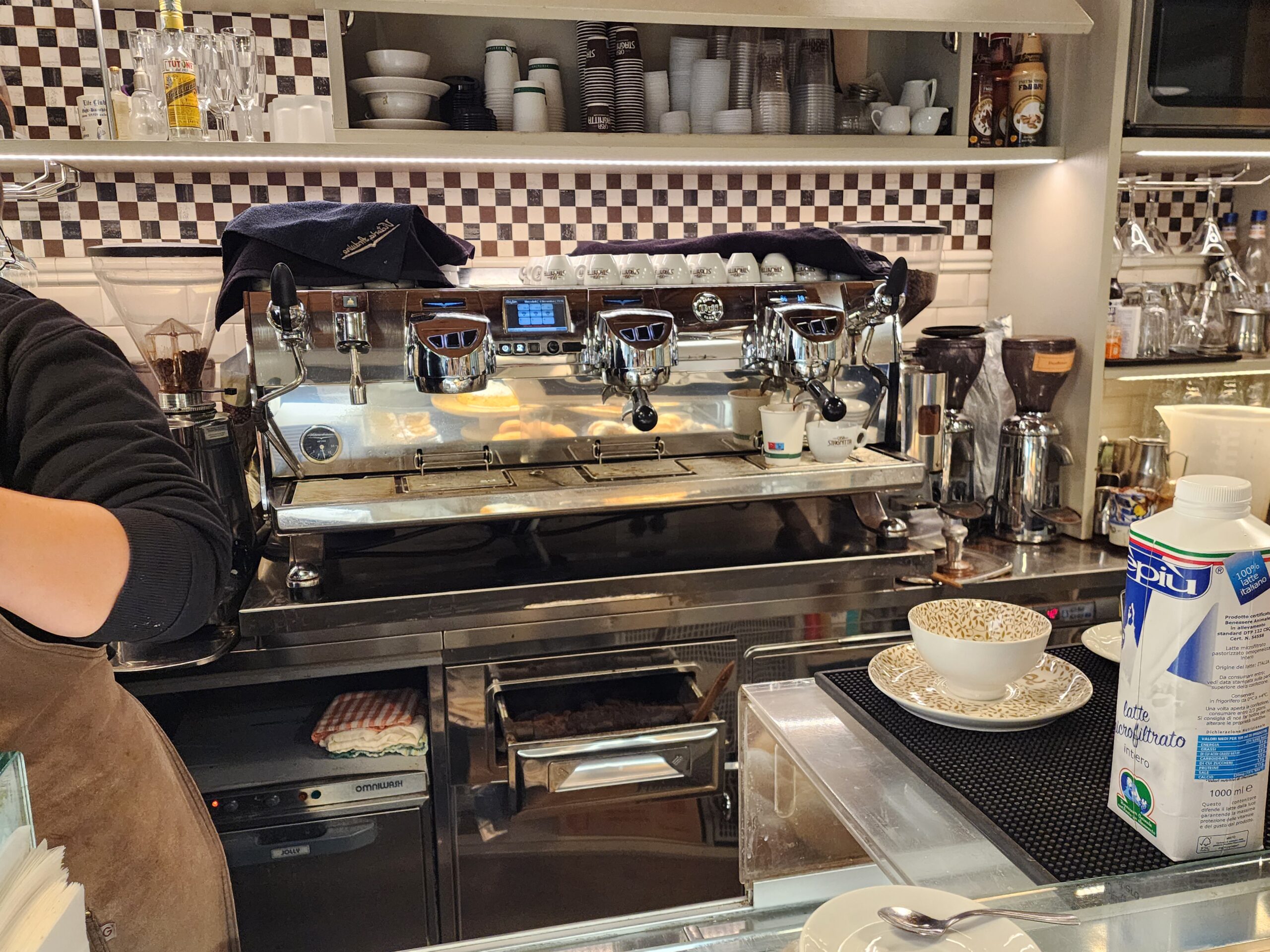
Brew by Weight, at the Drip Tray
On the gravimetric version, small scales sit in the drip tray under each group. Put the cup down, the machine tares it, and the shot weight counts up on the display above the group. At the target weight, the pump stops. A flow meter only knows how much water went into the puck. A scale knows how much espresso landed in the cup, so a slightly different dose or a fresh bag of beans doesn’t throw the yield off. The three-group holds up to six weight presets, the two-group four.
That counts most on a bar like this, where the same blend goes out hundreds of times a day and two people may be on the machine at once. Set it to stop at, say, 36 grams and every shot stops there. Whoever pulled it.
T3, Three Temperatures
Victoria Arduino calls its temperature system T3. Each group has its own 0.7-liter brew boiler, the steam boiler is separate, and the group head itself is heated and set on its own. The group-head setting is the quick lever. Nudge it a degree and extraction shifts within minutes, with no wait for a boiler to settle and no trip to the grinder. Our boiler types guide explains why separate boilers matter in the first place.
The steam side is big. The three-group carries a steam boiler of about 17 liters, enough for two baristas steaming at the same time, with cool-touch wands. Soft pre-infusion wets the puck gently before full pressure, which helps keep water from forcing its own path through the coffee (the problem we cover in espresso channeling explained).
What It Costs, and Who It’s For
This isn’t a home machine. US dealers list the gravimetric Black Eagle at roughly $28,600 for two groups and $34,650 for three. It needs a 220-volt line, a water connection and a drain, and the three-group weighs close to 300 pounds. Renewed units turn up for about a third of the new price. Victoria Arduino has since added the Black Eagle Maverick and dropped the volumetric VA388, so on the used market the gravimetric model is the one to look for.
So who buys one? A high-volume café, a roaster’s flagship bar, a competition stage. A Sicilian bar pouring a roaster’s own blend fits the profile well. When your name is printed on the cup, consistency is the whole job.
Brew by Weight at Home Costs a Scale
You don’t need a Black Eagle to brew by weight. A small espresso scale under the cup does the same job, with your finger on the switch. The Acaia Lunar is the café standard, and a cheaper espresso scale with a timer fits most home drip trays. Stop the shot at your target weight and you’ve got the Black Eagle’s main trick for the price of a dinner out.
And if you’d rather just drink the result, our guide on how to order coffee in Italy covers what to ask for at a counter like this one, and Italian espresso bar rules covers the etiquette.
The machine costs as much as a car. The idea behind it costs a scale.
As an Amazon Associate I earn from qualifying purchases.