Ask for un café in France and you’ll get an espresso, short and dark in a thick little cup, with a sugar cube or two on the saucer. Nobody asks what size you want. Anything else needs its own word, and the words aren’t the ones that work in Madrid or Lisbon.
If you drink cortados, the one to learn is noisette. It’s the nearest thing France has to a cortado, with less milk than the specialty café version. The rest of the list is short. A crème is the bigger coffee with milk, and an allongé is what you order when an espresso feels too small.

Un Café and the Words That Change It
An espresso has a few names. Un café is the everyday one. You’ll also hear un express, and older regulars sometimes ask for un petit noir. It’s the same shot whatever you call it.
From there you adjust it:
- Un serré: the same dose of coffee with about half the water, under 20 ml in the cup. Stronger and thicker.
- Un double: a double espresso.
- Un allongé: an espresso stretched with hot water. The water usually goes in after the shot, which makes it close to an Americano. If you’d rather have all that water run through the coffee, the word is un café long, though plenty of cafés treat the two as the same drink.
- Un déca: decaf espresso.
The Noisette Is the Closest Thing to a Cortado
A café noisette, usually shortened to une noisette, is an espresso with a little milk or cream, just enough to turn it the color of a hazelnut. That’s where the name comes from. It comes in the same small cup as a plain café.
Next to a cortado made the specialty way, with espresso and warm milk in roughly equal parts, the noisette is light on milk. It sits much closer to the cortado of an ordinary Spanish bar, where the milk is a splash. It’s also a near relative of the Italian macchiato and the Portuguese pingado, both of them an espresso marked with a little milk.
If a café’s menu lists a cortado by name, you’ll probably get the one-to-one version. Anywhere else, order a noisette and expect something smaller and stronger.
Crème, Café au Lait and the French Cappuccino
For more milk, order un café crème, or just un crème. It’s espresso topped up with hot milk, and despite the name it’s almost always milk. A grand crème is the big one and a petit crème the small one. A grand crème is roughly what most visitors picture when they think of a café au lait.
Café au lait itself is mostly a home drink. It’s filter coffee with hot milk, drunk from a wide bowl at breakfast, often with a tartine or a croissant on the side. Ask for one in a café and you’ll most likely get a crème.
The milk in an ordinary café is often UHT, the long-life kind, and you can taste it. Some cafés bring it in a small jug so you can pour it yourself, as in the photo below.
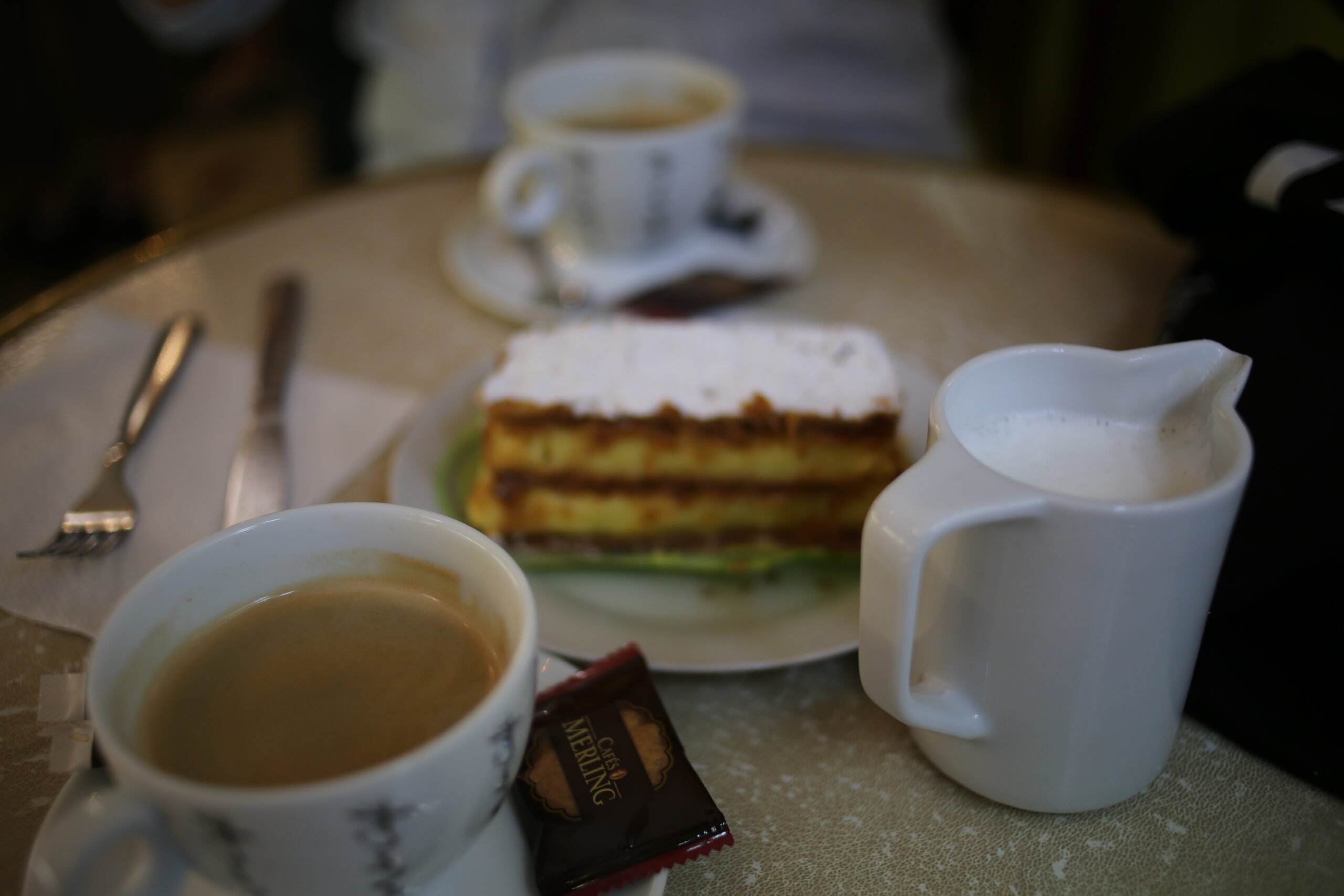
Cappuccino is on most menus, but don’t expect the Italian drink. French cafés often finish it with cocoa powder or a cap of whipped cream, like the cocoa-dusted pair in the first photo, and it usually costs a little more than a crème. You’ll rarely see a Parisian order one.
Counter or Table: The Price Board
Every café has to post its prices outside, and the list starts with une tasse de café noir, a cup of black coffee. French rules dating from 1987 set out what goes on that board, down to figures at least 1.5 cm high, and they show the price at the counter (comptoir) next to the price at a table (salle). Standing at the bar costs less.
How much less depends on the place. A 2023 survey of about 110 Paris cafés put the average espresso at €2.72, with prices running from €1 to €14. Outside Paris it’s usually cheaper.
Water is free. Since 2020 cafés have had to tell customers that tap water costs nothing, so ask for une carafe d’eau or un verre d’eau and you shouldn’t see it on the bill.
After Lunch: Café Gourmand
Restaurants have their own coffee order. A café gourmand is an espresso served with a few small desserts in place of a full one, a mini crème brûlée, say, or a financier. The La Criée restaurant chain says it came up with the idea in 1985; other accounts put it in the 1990s. By the late 2000s it had become a fashion across France.
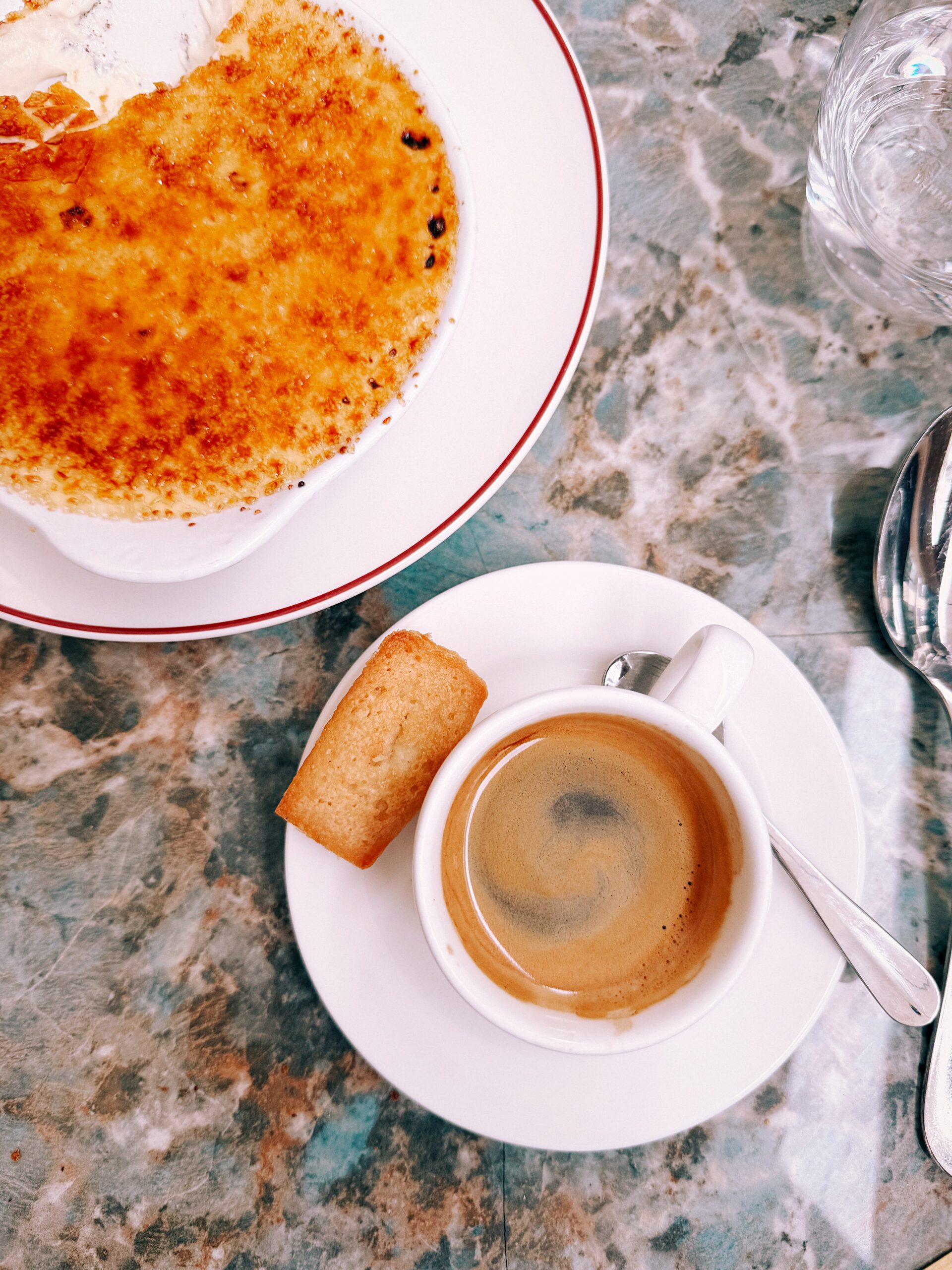
A plain café often comes with something small on the saucer too, a chocolate or a biscuit. There’s a story behind that, which we cover in why your espresso comes with a glass of water or a biscuit.
A Short Ordering List
- Un café: an espresso.
- Un serré: a shorter, stronger espresso.
- Un double: a double espresso.
- Un allongé: an espresso lengthened with hot water.
- Une noisette: an espresso with a spot of milk. The cortado’s French cousin.
- Un crème, grand or petit: espresso with hot milk.
- Un déca: decaf.
- Un cappuccino: expect cocoa or whipped cream on top.
If you’re only going to learn one, make it une noisette, s’il vous plaît. A cortado drinker will feel at home with it.